

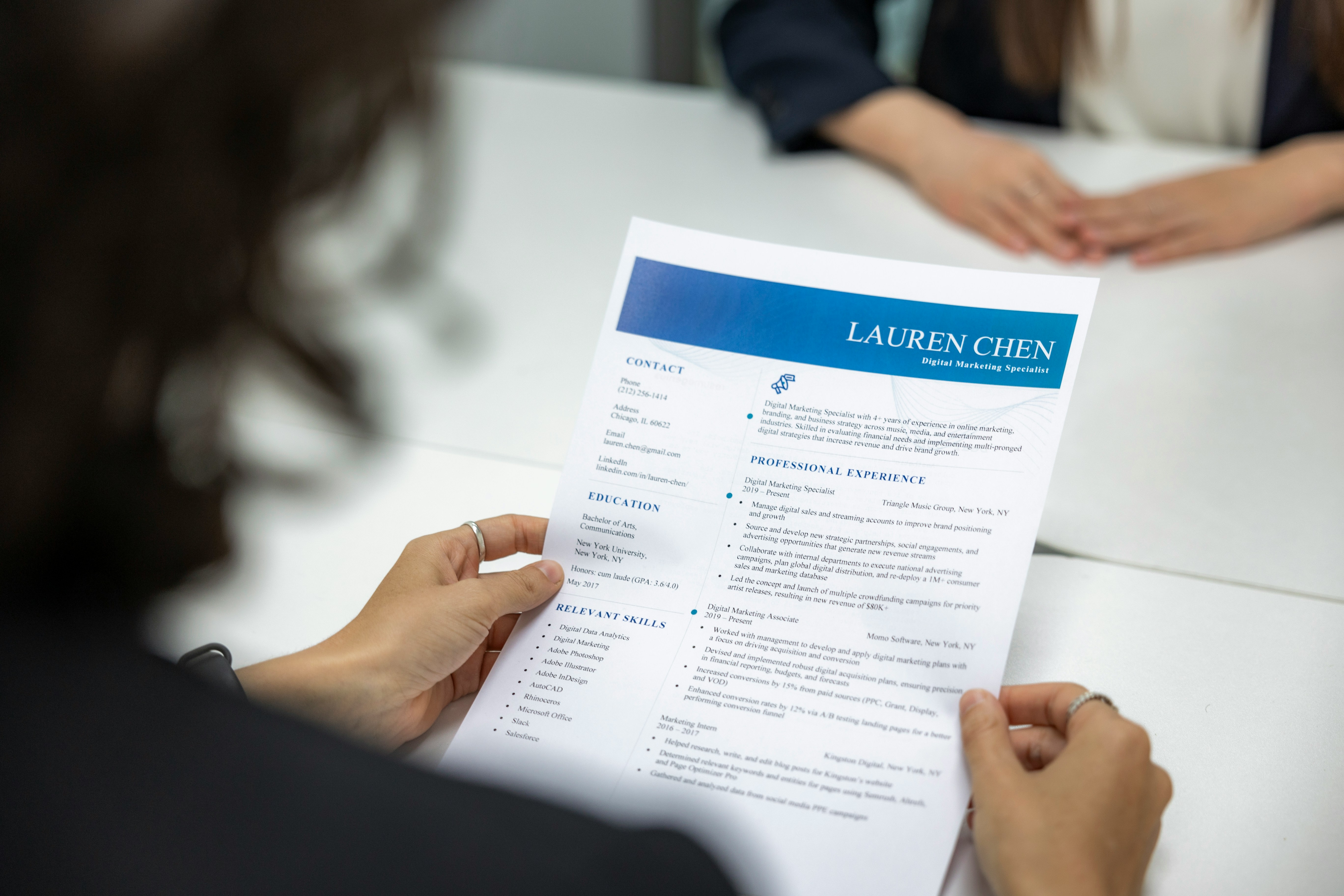
Applying for a job in another country is not as simple as taking the CV you use at home and sending it everywhere.
The basic information remains the same — your experience, education, skills and achievements — but the way you present that information can differ depending on the country, industry and employer.
A U.S. employer may expect a resume, while a British employer will normally ask for a CV. A German employer may expect a more detailed Lebenslauf, while an employer in the UAE may want information about nationality and visa status that would usually be unnecessary on a U.S. resume.
The most important rule is this:
Adapt your CV to the country you are applying to, then tailor it again to the specific job.
There is no single international CV format that works perfectly everywhere.
Before You Start: Build a Master CV
Before creating country-specific versions, create one master document containing your complete professional history.
Keep your:
Employment history
Education
Professional qualifications
Certifications
Technical skills
Languages
Projects
Awards
Volunteer experience
Publications
Professional memberships
Major achievements
You do not have to send this entire document to employers.
Instead, use it as your source document and create a targeted version for each country and job.
This makes international applications much easier to manage.
1. United States 🇺🇸
Use a resume for most jobs
If you are applying for a normal corporate, technology, finance, marketing, engineering or business position in the United States, the document you normally want is a resume, not an academic CV.
A U.S. resume is generally concise and focused on the experience most relevant to the position. For many applicants, one to two pages is appropriate.
What to include
A typical U.S. resume can contain:
Name
Phone number
Professional email
City and country
LinkedIn or portfolio
Professional summary
Skills
Work experience
Education
Certifications where relevant
Focus heavily on achievements and results.
Instead of:
Responsible for managing social media.
Use something closer to:
Managed social media campaigns across three platforms, increasing monthly engagement by 35%.
Only use numbers that are accurate.
What to leave out
For most U.S. corporate applications, avoid unnecessary personal information such as:
Photograph
Date of birth
Marital status
National identification number
Passport number
Religion
A U.S. employer is generally looking for evidence that you can perform the job, not a detailed personal profile.
Important exception: academic and research jobs
In the United States, CV and resume can mean two different documents.
A university professor, researcher or academic applicant may be asked for a full academic CV containing publications, research, teaching, presentations, grants and other academic achievements.
Do not send a long academic CV to a company that requested a resume.
2. United Kingdom 🇬🇧
Use a CV
In the UK, the standard term for the normal job application document is CV.
A concise, tailored CV of around two pages is a useful starting point for many professional positions.
Recommended structure
A UK CV can include:
Name and contact details
Personal profile
Key skills
Employment history
Education
Professional qualifications
Additional relevant information
Your most recent experience should normally appear first.
Personal profile
A short professional profile at the top can explain who you are, what you specialise in and what type of role you are targeting.
Avoid vague statements such as:
I am a hardworking person looking for an opportunity.
Instead, immediately communicate your professional value.
Photograph
For ordinary UK job applications, a professional photograph is generally unnecessary.
Do not automatically add one just because you are applying from a country where photographs are commonly used on CVs.
International applicants
If you are applying from outside the UK, be honest about your current location and work status.
If sponsorship may be required, investigate the employer's requirements before assuming that the vacancy will sponsor you.
3. Canada 🇨🇦
Use a resume for most professional jobs
Canadian private-sector applications generally follow conventions similar to the United States.
For most ordinary jobs, use a resume rather than a long academic CV.
Focus on:
Relevant experience
Achievements
Skills
Education
Certifications
Professional results
Keep it focused
Do not turn your Canadian resume into a complete biography.
The employer should quickly understand:
What can you do?
What have you achieved?
Why are you suitable for this position?
Avoid unnecessary personal information
For most Canadian professional applications, do not add information such as:
Age
Date of birth
Marital status
Religion
Passport number
Photograph
The goal is to keep the document professional and focused on your qualifications.
International applicants
If you are applying from outside Canada, pay attention to work-authorisation requirements.
Do not claim that you are legally entitled to work in Canada unless that is actually the case.
4. Australia 🇦🇺
Use a CV or resume
Australian employers use both terms, although resume is common in professional recruitment.
A two- to three-page document can be appropriate depending on your experience and profession.
The important thing is not to fill pages simply to make the document longer.
What Australian employers need to see
Your CV should clearly communicate:
Professional experience
Relevant skills
Education
Certifications
Achievements
Professional memberships
Relevant licences
A short professional summary can work well at the beginning.
Don't add a photograph just because you're applying internationally
For ordinary Australian professional applications, a photograph is generally unnecessary.
Focus the space on your professional evidence instead.
Selection criteria
Some Australian public-sector and other roles may ask applicants to address specific selection criteria.
If the employer asks for this, treat it as a separate requirement rather than trying to squeeze everything into your CV.
5. New Zealand 🇳🇿
Use a CV
New Zealand employers commonly use the term CV.
A concise but reasonably detailed CV can work well, particularly when your experience needs more explanation than would normally fit into a very short U.S.-style resume.
Focus on evidence
Instead of listing dozens of skills, show how you have used them.
For example:
Project Management
is weaker than:
Coordinated a six-month project involving four departments and delivered the project two weeks ahead of schedule.
The second example gives the employer evidence.
References
Some employers may request referees or references.
Follow the vacancy instructions rather than automatically filling your CV with personal contact details for previous managers.
6. Germany 🇩🇪
Use a structured German-style CV
Germany has a stronger tradition of the Lebenslauf, and the presentation can be more structured and detailed than a typical U.S. resume.
A German application can also involve documents beyond the CV, depending on the employer and position.
Keep the structure clear
A German CV commonly presents:
Personal information
Professional experience
Education
Skills
Languages
Certifications
Other relevant qualifications
Employment and education are usually presented clearly in chronological order, often with dates that are easy to scan.
Photograph and personal information
A professional photograph and certain personal details have traditionally been common in German CVs.
However, this is an area where applicants should avoid treating tradition as a universal requirement.
Check the employer's current instructions and the norms for your industry before adding personal information.
Language matters
If the vacancy is written in German and requires German, submitting an English CV may not be appropriate unless the employer specifically accepts it.
If the employer accepts English applications, make sure your professional terminology is clear and natural.
7. Netherlands 🇳🇱
Keep the CV concise and relevant
Dutch employers generally value clarity and direct communication.
A CV should make it easy to understand:
What you do
What experience you have
What skills you offer
Why you fit the position
Avoid filling the document with unnecessary paragraphs.
Tailor your CV
If the job requires five specific skills and you genuinely have them, make those skills visible.
Do not simply create a large "Skills" section containing every software package, hobby and ability you have ever used.
Photograph
Photograph conventions can vary by industry and employer.
Do not assume that a photograph is mandatory.
Check the vacancy and employer expectations before including one.
8. Ireland 🇮🇪
Use a CV
Irish employers generally use the term CV for professional job applications.
A concise CV, often around two pages for experienced applicants, is a useful starting point.
Structure
A practical Irish CV can include:
Contact details
Professional profile
Key skills
Employment history
Education
Certifications
Additional relevant information
As with the UK, focus on recent and relevant experience.
Don't copy your home-country format blindly
If your home-country CV contains extensive personal information, photographs or unrelated details, do not automatically carry all of it into an Irish application.
Follow the vacancy and local professional conventions.
9. United Arab Emirates 🇦🇪
Use a detailed professional CV
The UAE is different from many Western markets because recruitment is highly international and employers may need information relevant to relocation and employment eligibility.
A two- to three-page CV can be appropriate, particularly for experienced professionals.
Information that can be useful
Depending on the employer and role, applicants may provide information such as:
Nationality
Current location
Languages
Visa status
Availability or notice period
Professional certifications
Relevant international experience
However, do not add sensitive information simply because someone says every UAE CV must contain it.
The employer's requirements should come first.
Photograph
Professional photographs are more commonly seen on UAE CVs than on U.S. or UK resumes.
Whether you should include one can depend on the industry and employer.
For multinational companies, the recruitment team may follow international corporate standards rather than traditional local CV practices.
Highlight international experience
If you have worked across different countries, dealt with international clients or worked in multicultural teams, make that experience visible.
That can be particularly useful in an international employment market.
10. Singapore 🇸🇬
Keep the CV professional and targeted
Singapore is a major international business centre, particularly for technology, finance, engineering, healthcare and professional services.
Your CV should clearly demonstrate the qualifications and experience required by the specific vacancy.
Focus on relevant achievements
If the job requires data analysis, don't simply write:
Data analysis
Explain what you actually did:
Analysed monthly sales data and created dashboards used by management to identify underperforming product categories.
International applicants
If you are applying from overseas, make your location clear and answer questions about work authorisation honestly.
If the employer specifically requests information about nationality or work status, provide it accurately.
What About Other Countries?
The same principle applies when applying elsewhere.
For example:
France — CVs tend to be concise and professionally structured.
Spain — photographs and personal information can be more common than in the UK or U.S.
Switzerland — detailed, carefully structured applications are common.
Japan — some employers use specific application formats such as the rirekisho alongside a more conventional career document.
South Africa — CV is the normal term, and comprehensive CVs are common in many sectors.
The important lesson is that there is no universal international CV.
International CV Comparison
| Country | Common document | Typical approach | Photo |
|---|---|---|---|
| 🇺🇸 United States | Resume | Short, targeted, achievement-focused | Generally no |
| 🇬🇧 United Kingdom | CV | Usually around two pages, tailored | Generally no |
| 🇨🇦 Canada | Resume | Concise and achievement-focused | Generally no |
| 🇦🇺 Australia | Resume/CV | Often more detailed than U.S. resume | Generally no |
| 🇳🇿 New Zealand | CV | Clear, relevant and moderately detailed | Generally no |
| 🇩🇪 Germany | Lebenslauf/CV | Structured and detailed | Can be common |
| 🇳🇱 Netherlands | CV | Concise and relevant | Depends |
| 🇮🇪 Ireland | CV | Similar to UK-style applications | Generally no |
| 🇦🇪 UAE | CV | Detailed, internationally focused | Can be common |
| 🇸🇬 Singapore | CV/Resume | Professional and targeted | Depends |
These are general market conventions, not mandatory rules. A particular employer may request something different, and that instruction should take priority.
The Most Important Difference: CV vs ResumeOne of the biggest mistakes international applicants make is assuming that "CV" and "resume" always mean the same thing.
In the United States and Canada, a resume is normally the short professional document used for most jobs.
A CV in those markets can instead refer to a much longer academic or research record.
In the UK, Ireland, Australia, New Zealand and much of Europe, "CV" is commonly the normal term for the professional job-application document.
So if a U.S. technology company asks for a resume, don't send a ten-page academic CV.
Likewise, if a UK employer asks for your CV, they are normally asking for the professional document containing your relevant experience, education and skills.
Don't Create Ten Completely Different CVsYou do not need to start from zero every time you apply to another country.
Instead, use a three-step system.
Step 1: Master CV
Keep your complete career information in one document.
Step 2: Country version
Adapt the format, terminology and personal-information sections for the country.
Step 3: Job version
Tailor the final version to the actual vacancy.
This approach saves time while still giving each employer a relevant application.
The Job Advertisement Always Comes FirstCountry conventions are useful, but the job advertisement is more important.
If an employer specifically says:
"Please submit a one-page resume."
Do not send three pages simply because three pages are common in your home country.
If an employer says:
"Please include a photograph."
Follow the instruction if appropriate.
If an employer asks for a cover letter, selection criteria statement, portfolio or additional documents, provide them.
The country gives you a starting point.
The employer gives you the final instructions.
Common International CV MistakesUsing one CV everywhere
A generic CV often fails because it does not emphasise the experience relevant to each vacancy.
Including too much personal information
Information that is normal in one country can be unnecessary or undesirable in another.
Using the wrong document
A U.S. corporate employer asking for a resume generally does not want a long academic CV.
Ignoring language requirements
If the position requires German, French, Dutch or another language, your CV may need to be prepared accordingly.
Hiding your location
If you are applying internationally, employers need to understand where you are currently based.
Misrepresenting work authorisation
Never claim to have a visa, work permit or right to work if you do not.
Using a complicated design
International applications may pass through recruitment software before reaching a human recruiter.
A simple, readable structure is usually safer than a heavily graphic CV.
Copying keywords without the skill
Never add a technology, qualification or skill simply because it appears in the vacancy.
Your CV should remain truthful.
How to Make an International CV Stand OutThe best international CV is not necessarily the most colourful or longest.
It is the one that answers the employer's questions quickly.
Who are you?
What can you do?
What have you achieved?
Why are you suitable for this particular position?
Are you eligible to work in the country, or will you require sponsorship?
If your CV answers those questions clearly, you are already ahead of many poorly targeted applications.
Final Checklist Before Applying AbroadBefore submitting your application, ask:
Did I use the document format expected in this country?
Did I follow the employer's instructions?
Is the CV tailored to this particular job?
Are my most relevant skills easy to find?
Did I explain achievements rather than only responsibilities?
Are my qualifications clearly explained?
Did I use appropriate terminology for the destination country?
Did I avoid unnecessary personal information?
Is my work-authorisation status represented honestly?
Is the document easy to read?
Have I checked spelling and grammar?
Are all claims accurate?
Did I include every document the employer requested?
Final Thought
Applying for jobs internationally requires more than translating your existing CV.
You are communicating with an employer who may have different expectations about how professional experience, qualifications and personal information should be presented.
The best strategy is not to create a completely different professional identity for every country.
Keep your facts the same. Change the presentation where necessary. Tailor the content to the job.
That gives international employers a clear picture of what you can offer while helping you avoid one of the most common mistakes in overseas job applications: sending the same CV everywhere.



Comments